
Hannah Ireland, The Second Hand is Turning

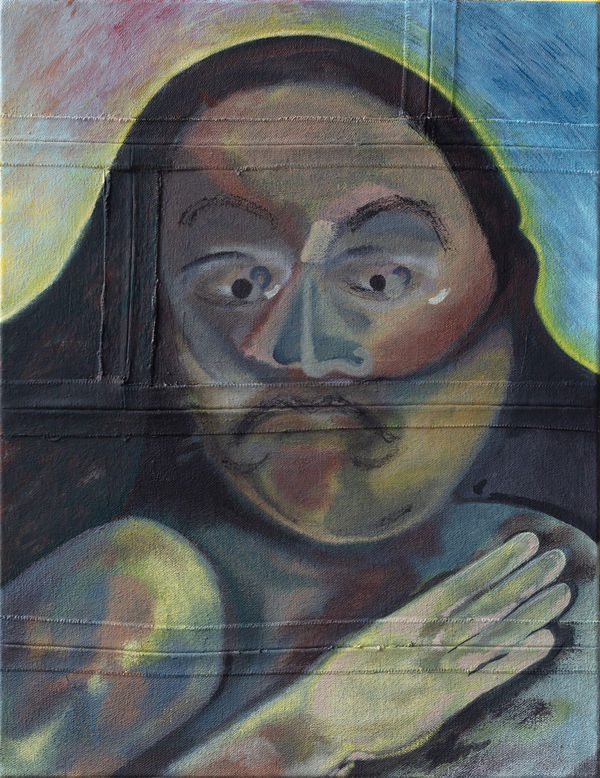
Time moves differently in Hannah Ireland’s paintings. Faces surface, dissolve, and re-form, held in a continual state of becoming. In this new body of oil paintings on canvas, Ireland works within a consistent portrait format—head and shoulders—establishing a shared structure through which each figure can unfold. Within these parameters, she draws on a personal vocabulary of marks, symbols, and gestures: an evolving visual shorthand through which memory, emotion, and sensation are translated into paint.
Ireland approaches portraiture not as a means of recording likeness, but as a way of navigating emotional and psychological terrain. Her figures exist in tension between concealment and revelation, distortion and clarity, emerging through processes of layering, revision, and intuitive response to material. Recognition is partial and unstable. At times the faces press forward toward the viewer; at others, they recede into fields of colour and gesture. The act of looking becomes reciprocal and unsettled—the viewer observes the painting, while simultaneously becoming aware of being held within its gaze. The body shifts from subject to landscape: a space to move through rather than simply observe.
Working across a sequence of similarly scaled canvases, Ireland embraces painting as a site of accumulation and discovery, allowing gesture and material to guide each composition. Acts of selection, flattening, and revision echo processes of cutting and pasting—revealing some elements while withholding others, and allowing each figure to remain in flux.
A single large-scale painting interrupts this measured rhythm. Operating as a structural and emotional axis within the exhibition, it gathers and expands the concerns of the surrounding works—shifting the encounter from the intimacy of the individual portrait toward something more collective, porous, and spatial. Here, portraiture opens outward, becoming not only an image of presence, but a field through which presence moves.
A poem by Ada Duffy accompanies the show.




small fortunes
Ada Duffy
I run without moving
fixated on symmetry. my tattooed tears,
my birthmarks darken in Hineraumati’s breath.
I draw ink blue curtains in the lounge
and watch them blend into night,
then recede from the sepia and faded pink
before dawn, scratching at my dry wrists
I picture burnt bridges,
their faces tactile in sleep.
/
these afternoons I run
my mouse along the Pacific.
noses of land breach the surface.
my eyes bring the contrast of islands seen
to where there is nothing but blue and gridlines.
I superimpose a past on a present.
/
spilt gumboot tea stuck some cardboard
to the bedside table. call it papier mâché.
each day that I make a mess I make a mask
for me to wear.
/
harakeke leaves on a path
fallen from the trunk and branches
of a very old rimu at the native reserve.
a plant that grows on another plant is called
an epiphyte.
epiphytes do not harm their home plant.
/
my love,
do you ever picture a forest in a grey area?
where daisies are three metres tall?
and they climb each other’s shoulders
to see Moko, the rimu, at the crown?
where would you say Moko’s eyes are?
can you see them in the dark?
my love, why do I make faces in everything?
/
I can never know what someone else thinks.
/
walking through a fallen tree, trunk severed
for the path, feels like prying.
caught in thick air, wairua of their body.
but lichen has made home here, the light open
without a canopy overhead.
they will return the marrow to new soil
sometime that I can’t count.
/
when I lived in a sleepout,
I liked to feel my way in the dark.
/
might I home a way outside,
look up and find the absence where I came from,
hyperbole myself into rain
to feel where harakeke rooted onto Moko,
then rest my nose in the corner
of my love’s eye.
