
Bronwyn Holloway-Smith, Marvellous Machines

Jhana Millers is pleased to present a small series of drawings by Bronwyn Holloway-Smith in the gallery foyer.
These works draw on early personal computing history in Aotearoa. Three intricately pencil-rendered scenes inspired by local 1980s technology ads and computer folklore feel both familiar, and slightly uncanny.
Stoned_01 revisits the story of one of the first global PC viruses, created in Wellington in 1987, which famously declared “Your PC is now Stoned!”. Shown here on an IBM terminal, the message takes on new resonance when viewed from a later moment shaped by pandemics and political referenda. The two Marvellous Machine works are inspired by advertisements from Bits & Bytes, a New Zealand computing magazine, where early technologies were often “humanised” through gesture, symbolism, and spectacle.
Holloway-Smith’s practice is known for its sharp attention to overlooked histories, particularly where technology, power, and belief intersect. Her current exhibition Wheel of Avalon at The Dowse Art Museum extends these concerns, weaving together an examination of communications systems, myth, and collective memory. The works presented here sit alongside that wider project, offering a quieter and more intimate entry point into its ideas.




Marvellous Machines brings together three works by Bronwyn Holloway-Smith that draw on early personal computing history in Aotearoa. Rendered with meticulous attention in pencil and paint, these scenes are adapted from 1980s New Zealand technology advertisements and local computer folklore. Familiar yet faintly unsettling, they evoke a moment when emerging digital systems were still closely tethered to the body, belief, and imagination.
At the centre of the presentation is Stoned_01 (2020), a drawing that revisits the story of one of the first global PC viruses. Created in Wellington in 1987, the “Stoned” virus famously declared “Your PC is now Stoned!” and circulated rapidly throughout New Zealand, Australia, and beyond. In Holloway-Smith’s rendering, the original text appears on an IBM terminal, its stark message accompanied by the reflection of a shadowy figure. While rooted in a specific local history, the work took on renewed resonance when it was first made in 2020 — a year shaped by another kind of virus, alongside a national referendum on cannabis legalisation. The work collapses past and present, revealing how technological events accrue meaning across time.
The two Marvellous Machine works (2026) extend this inquiry through imagery drawn from Bits & Bytes, a New Zealand personal computing magazine published between 1982 and 1998. These advertisements frequently attempted to “humanise” early computers through the use of models, gestures, or disembodied hands. Seen now, Holloway-Smith renders these strategies with a quiet precision that allows their strangeness to surface. What was once intended to reassure instead feels uncanny, as bodies appear partial, symbolic, or oddly subordinate to the machine.
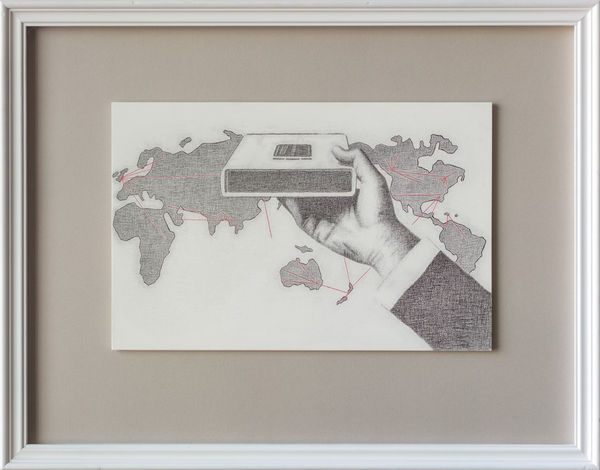
MarvellousMachine_01 depicts a hand holding a modem against a loosely drawn world map, with lines of connectivity radiating outward from locations of geopolitical significance to New Zealand. The image gestures toward global communications infrastructures while echoing Holloway-Smith’s earlier research into the Southern Cross Cable.
MarvellousMachine_02, drawn from a late-1980s advertisement featuring the late Tim Shadbolt, depicts a BBC Master Series microcomputer. The original advertisement incorporated the phrase “marvellous machine” alongside an image of the computer topped with a graduation cap — a wry, ironic detail given the internet’s profound and ongoing impact on education, expertise, and the production of knowledge.
Across her practice, Holloway-Smith is known for her sustained attention to overlooked histories where technology, power, and belief intersect. Her work traces the cultural and ideological frameworks that sit beneath seemingly neutral systems, from telecommunications infrastructure to mythic narratives and collective memory. This approach is evident in her current exhibition Wheel of Avalon at The Dowse Art Museum, which weaves together communications systems, legend, and ritual to consider how meaning is transmitted and transformed over time.
The works in Marvellous Machines sit alongside that wider project, offering a quieter and more intimate entry point into Holloway-Smith’s thinking. Through careful drawing and historical specificity, they reveal moments when technological futures were still uncertain — charged with optimism, anxiety, and a desire to make the machine feel human.